
Should this workflow be an agent?
Use an agent when the next step must change with the evidence and a model can pick from a bounded set of actions. If the sequence is known, start with a workflow instead.
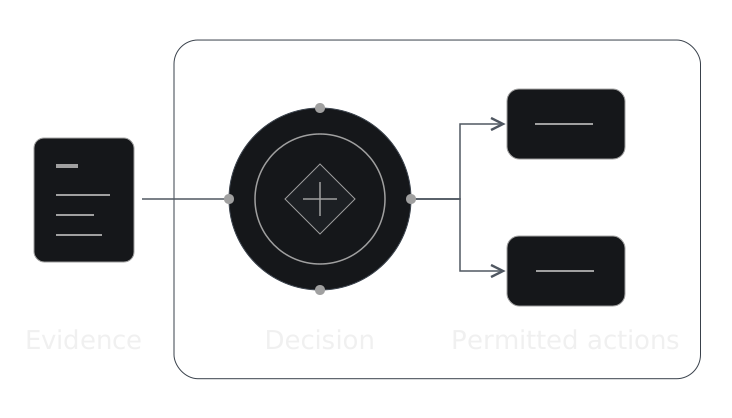
Name the decision the system must make
Receiving a supplier file and routing it can follow explicit rules. Reading an unfamiliar document and flagging missing evidence may need a model. Choosing the next source to check may justify an agent.
Using a model does not make the whole process an agent. Anthropic distinguishes fixed workflows from agents that direct their own process and tools, and recommends starting with the simplest approach. Read its engineering guide.
Write the boundary before selecting the tools
Describe the task in terms an operator can challenge: what starts it, what counts as done, what it reads, what it can act on, and what happens when evidence conflicts.
The supplier system might read submitted files and draft a request for missing information. Sending it needs a person’s approval, a separate permission even inside one interface.
Use a fixed workflow when the path is known
Explicit steps are easiest to inspect when the same conditions give the same decision, with validation and access checks in ordinary code. The workflow still needs testing and an owner.
An agent is worth evaluating once a fixed sequence keeps failing because the system must choose which evidence to gather next.
Test the action, not just the answer
An agent that writes a plausible explanation can still choose the wrong tool or repeat an action. Test with real examples, including failures the operator has seen.
- Check whether the action was permitted and useful.
- Test missing evidence, unavailable tools and conflicting instructions.
- Set limits on repeated attempts and a path back to a person.
- Measure completion, corrections and time against the existing process.
- Confirm a reviewer can approve the action before a consequential write.
Increase autonomy only when the evidence supports it
Begin with recommendations or drafts, enough to test the judgement. If the system earns permission to act, grant the narrow action needed and keep the ability to stop.
The deliverable is an operating boundary people understand. AURA LOGIC LABS scopes it through Decision Agents, then connects evaluation and support through Production Governance.
Related reading
Review the workflow before you build.
Bring the workflow and the steps a person must still approve.